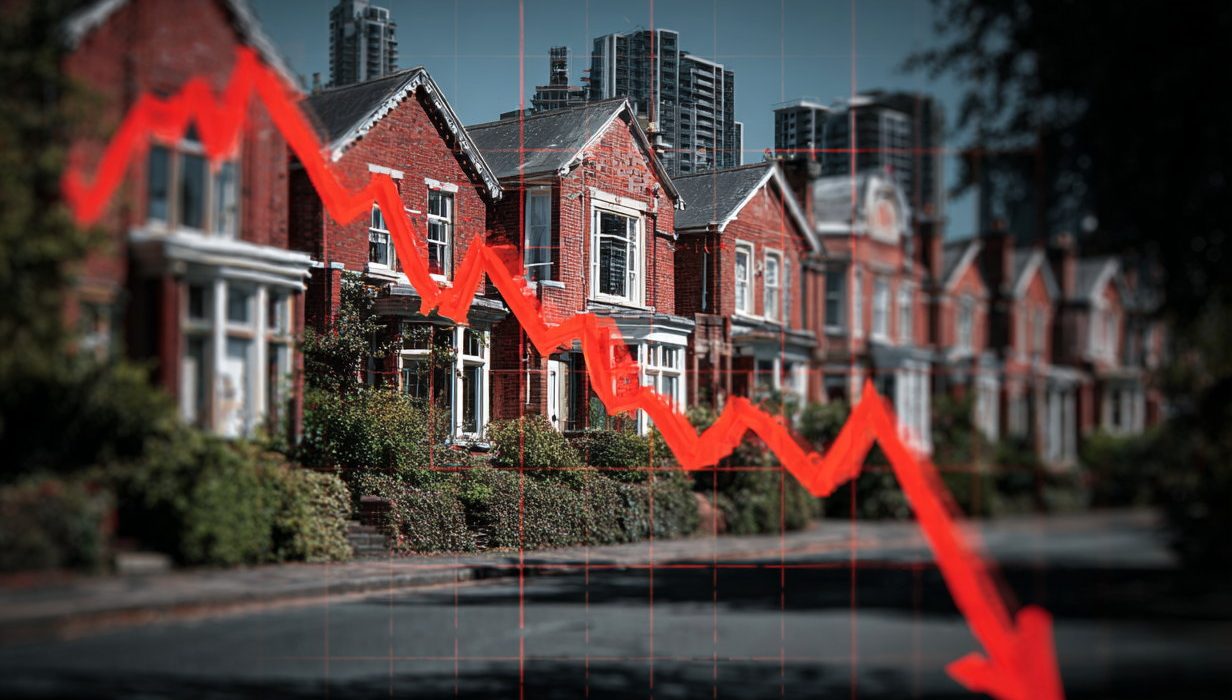
US housing market struggles in 2026 as high mortgage rates, weak demand, rising supply, and affordability crisis keep home sales slow and prices largely stagnant nationwide.
America‘s housing market in 2026 has frozen in place. Despite more homes trickling onto the market, US home sales have plunged to a nine-month low, mortgage rates are stuck above 6%, and median prices hit a fresh March record, a combination that has squeezed buyers out and kept sellers locked in. Existing-home sales fell 3.6% in March to a seasonally adjusted annual rate of 3.98 million units, the slowest March pace since the 2009 financial crisis, according to the National Association of Realtors (NAR).
Builder confidence has slumped to its lowest reading since September 2025, and J.P. Morgan now expects US home prices to stall at 0% growth nationally through 2026. What began as a cyclical slowdown has hardened into a structural standstill, driven by the Iran war, a cooling US labour market, and the mortgage-rate “lock-in” effect that has immobilised an entire generation of homeowners.
Builder sentiment slumps as buyer traffic collapses
The NAHB/Wells Fargo Housing Market Index fell four points to 34 in April, its weakest level since September 2025, with current sales conditions, six-month expectations and prospective-buyer traffic all posting declines. “Builder sentiment has fallen back in spring as buyers face ongoing elevated interest rates and growing economic uncertainty,” said NAHB Chairman Bill Owens, a home builder from Worthington, Ohio.
“The year started with hopes for housing momentum growth, but risks with respect to the Iran war, energy costs, and declines for consumer confidence have slowed the market.”Builders are pulling every lever to keep sales moving, but with limited success. Around 36% of builders cut prices in April, and 60% are offering sales incentives, the 13th straight month the incentive share has stayed at 60% or higher.
Affordability is the biggest hurdle
High prices colliding with high mortgage rates remain the core drag. The 30-year fixed-rate mortgage averaged 6.18% in March, up from 6.05% in February, according to Freddie Mac. NAR’s Housing Affordability Index slipped to 113.7 in March from 117.5 in February.
“Higher policy rates weighed on not just demand but also supply, as current homeowners were reluctant to move and sacrifice lower mortgage rates. Prices were thus kept high despite a fall in demand,” said Joseph Lupton, a global economist at J.P. Morgan, in the bank’s “US Housing Market Outlook” report. Many American homeowners locked in ultra-low mortgage rates during the pandemic and are now refusing to trade them for rates above 6%. That has throttled the supply of existing homes, even as elevated borrowing costs push buyers to the sidelines.
US home sales are weak across every region
The slowdown is visible in every corner of the country. Existing-home sales fell in all four US regions in March: the Northeast dropped 8.5%, the Midwest 4.2%, the South 3.6%, and the West 1.3%. “March home sales remained sluggish and below last year’s pace,” said NAR Chief Economist Dr. Lawrence Yun. “Lower consumer confidence and softer job growth continue to hold back buyers.”
Inventory rose 3% month-on-month to 1.36 million units, a 4.1-month supply, but remains historically tight. “The inventory-to-sales ratio, or supply-to-demand ratio, is below historical norms,” Yun said. “An additional 300,000 to 500,000 homes for sale would help bring the market closer to normal conditions and allow consumers to make purchase decisions without feeling rushed.”
Home prices aren’t falling — they’re still rising
Even with weak demand, US home prices have barely budged. The median existing-home price rose to $408,800 in March, up 1.4% year-on-year — the 33rd consecutive month of YoY price gains and a record high for any March, per NAR data. In a normal cycle, higher interest rates would cool prices; in this cycle, limited supply and low homeowner mobility have kept them elevated.NAR has also trimmed its 2026 forecast: existing-home sales are now expected to rise just 4% this year, down from a prior projection of 14%. Median prices are still forecast to rise 4%.
Uncertainty and the Iran war have frozen buyers
Mortgage rates had been easing in early 2026, the 30-year fixed dropped to 5.98% in late February, helped by expanded mortgage-backed securities purchases by Fannie Mae and Freddie Mac. But rates rebounded after the outbreak of the US-Iran war, compounded by fresh inflation concerns. “Some buyers feel like they’re frozen, they don’t know how to make their decisions because events like the ones we’re talking about spring up so rapidly and so out of our control,” Andrew Vallejo, an estate agent in Austin, Texas, told the BBC.
Indicators point to “weakening housing demand following a recent jump in mortgage rates and a collapse in consumer confidence,” Thomas Ryan of Capital Economics told the BBC. A softening US labour market, nonfarm payrolls have declined in six of the last 15 months, is compounding the paralysis. “This has restricted an important channel that typically spurs both supply and demand in the housing market, as people with jobs and low mortgage rates are now further disincentivised from moving,” Lupton added.
Supply is rising: but not enough to fix the market
New construction is picking up, and in some pockets of the West Coast and Sun Belt, excess inventory is already dragging prices lower. “Overbuilding is a sure path to home price declines, and builders have been navigating an increasing supply of new homes,” said John Sim, head of Securitized Products Research at J.P. Morgan. But at the national level, the increase in supply still isn’t enough to rebalance the market, J.P. Morgan estimates the structural shortfall at around 1.2 million homes, well below the 3–5 million often cited.
US home prices expected to stall in 2026
J.P. Morgan expects prices to plateau rather than decline this year. “Lower adjustable-rate mortgage rates and builder buydowns could be enough, along with a rising wealth effect, to shift demand higher while supply increases subside. Consequently, we expect home prices to stall at 0% nationally in 2026,” Sim said. Fixed rates, however, are projected to stay above 6% through the year.
Policy fixes may not move the needle
The Trump administration’s recent housing reforms, a proposed ban on institutional investors buying single-family homes and a directive for Fannie Mae and Freddie Mac to buy up to $200 billion in mortgage-backed securities, are unlikely to shift the dial, J.P. Morgan argues. Institutional investors make up only 1–3% of the market. And the $200 billion MBS purchase accounts for just 1.4% of the $14.5 trillion mortgage market, likely reducing 30-year mortgage yields by only 10–15 basis points. “Most homebuilders already offer potential buyers mortgage rate buydowns of 100 bp to as much as 200 bp below the prevailing mortgage rate,” said Michael Rehaut, head of U.S. Homebuilding and Building Products Research at J.P. Morgan. “As a result, we do not believe a modest lowering of the market mortgage rate will have a material impact on demand.”